Vegetation softens the architectural presence, which reinterprets traditional Lombard forms through contemporary materials and shapes.
Vegetation softens the architectural presence, which reinterprets traditional Lombard forms through contemporary materials and shapes. Mitigating the perception of an industrial environment through greenery — this principle guided the design choices behind the project, which involves the construction of three distinct buildings arranged on a trapezoidal 64,000 m² plot located along the former State Road 412, between the urban center of Torrevecchia Pia and the nearby village of Vigonzone.
The Barreca & La Varra studio oversaw the project in its entirety:
from the masterplan layout to architectural design, landscape planning, and interior design. One of the key requests from the client, since the early stages of the project, was to create a single entrance for all company employees, despite their different functions within the headquarters (sales, administrative, and production staff). This immediately required the development of a design concept emphasizing fluidity — both in terms of internal layouts and volumetric and architectural composition — leading to the creation of an open courtyard configuration. Balancing the spatial needs of the production sector with those of the tertiary sector demanded a structural design that allowed different construction systems (cast-in-place for the office areas and prefabricated for the warehouse and production spaces) to coexist without compromising the unified architectural image. The resulting volumes, inspired by the archetypal gabled house form, aim to give a human and domestic scale to the large complex. From certain perspectives, their composition evokes almost metaphysical scenarios, to which the frequent local fog lends an evocative and fitting backdrop.
The buildings interlock while remaining structurally independent, and this interaction defines the architectural façades, which externally express the structural systems to which they belong.
Three main materials were chosen to characterize the volumes: a medium-gray GRC ventilated façade, prefabricated concrete panels with different surface finishes, and painted corrugated metal sheets crowning all the roofs. The project’s distinctiveness lies in the meticulous pursuit of harmony and continuous dialogue between these elements. The intent to create an orderly, disciplined workspace led to an almost obsessive study of material relationships and alignments between spatial and architectural components at various scales (interior layout, façade design, outdoor space organization, and urban furnishings), while also allowing for distinctive and refined “exceptional” details and objects.
The 3,000 m² office building, spread over two floors, reinterprets the traditional Lombard farmhouse with an open courtyard layout, embracing four large trees that animate the collective space.
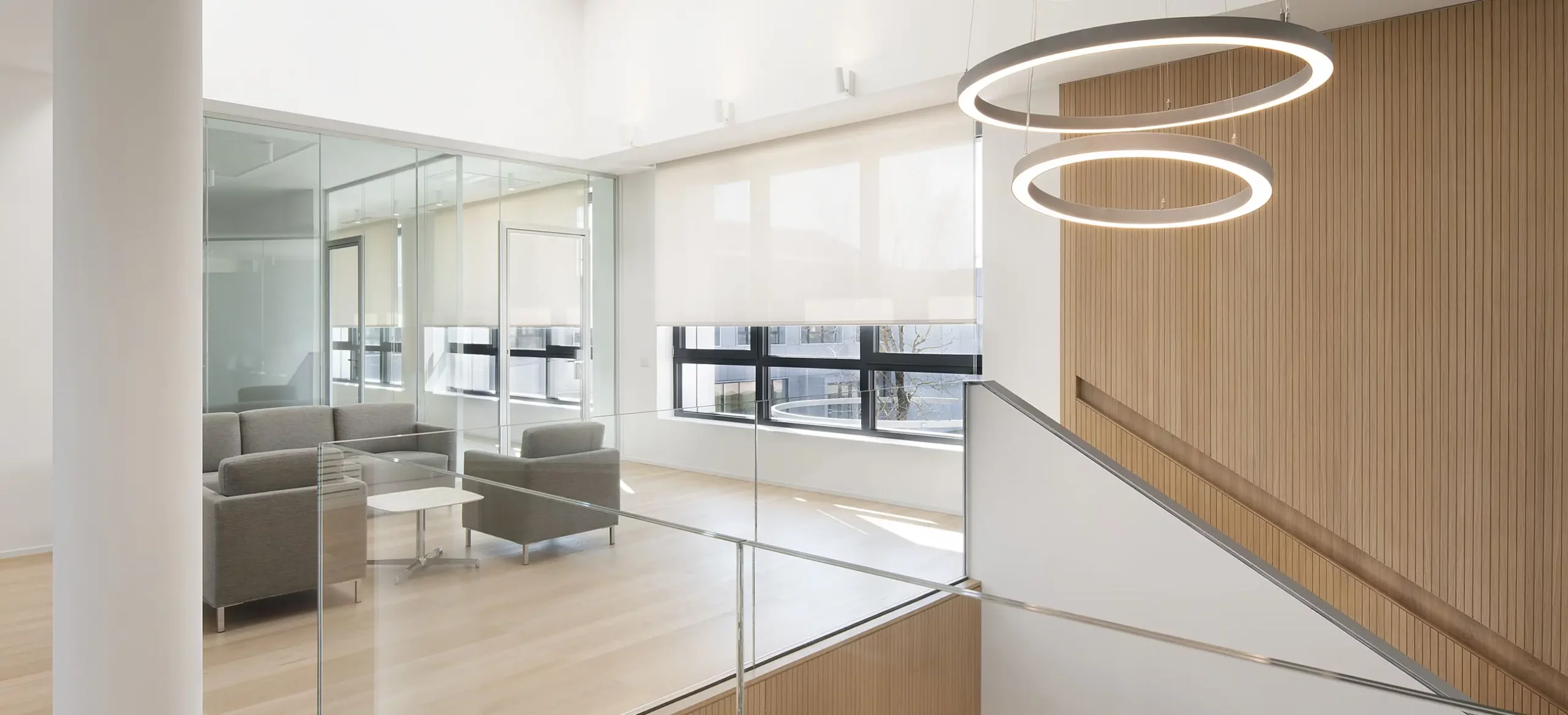
Four entrance lobbies—two of which are double-height and illuminated by skylights—distribute the internal spaces composed mainly of meeting rooms and open-plan offices. The interiors are defined by the pairing of sober yet refined materials, crafted with exceptional care and attention to detail. Notable examples include solid wood paneling that clads the main lobbies, seamlessly continuing onto the wooden stair flooring. The interior spaces maintain a constant sense of connection through large glass walls that visually link different areas and foster interaction among building users. For this reason, wood finishes were also chosen for the office areas, where movable walls and built-in furniture are made of oak. References to the industrial environment are echoed in the flooring: in the lobbies, cement-effect resin floors match the tones of the production and warehouse flooring, while in the office areas—where raised flooring is used to ensure maximum flexibility for systems and future upgrades—rolled cement-effect porcelain tiles were selected.
Adjacent to the offices lies the 5,500 m² production area.
Visible through window openings from the “research and development” section located on the second floor of the office building. This volumetric continuity is intended to further align the roles of production and administrative staff, while visually unifying the overall complex. The 5,700 m² warehouse building, on the other hand, is independent, with its main façade facing a 3,000 m² parking area offering 180 spaces for visitors and employees. The warehouse is fully accessible around its perimeter for vehicle operations.